Tools that
help you
create.
Ferric is one person and a laptop, across a lot of years of chasing sounds, picking up instruments, and making things in rooms that weren't studios. The kit I kept wishing existed — built so the next person doesn't have to wait for it.
“The bench” is the desk these get made on — the workbench, in the old sense of a shop where things are built by hand and repaired in the open. On the bench means still being worked on. Off the bench means it ships. A bench note is what gets written while the work is happening, and the regulars are who it goes out to.
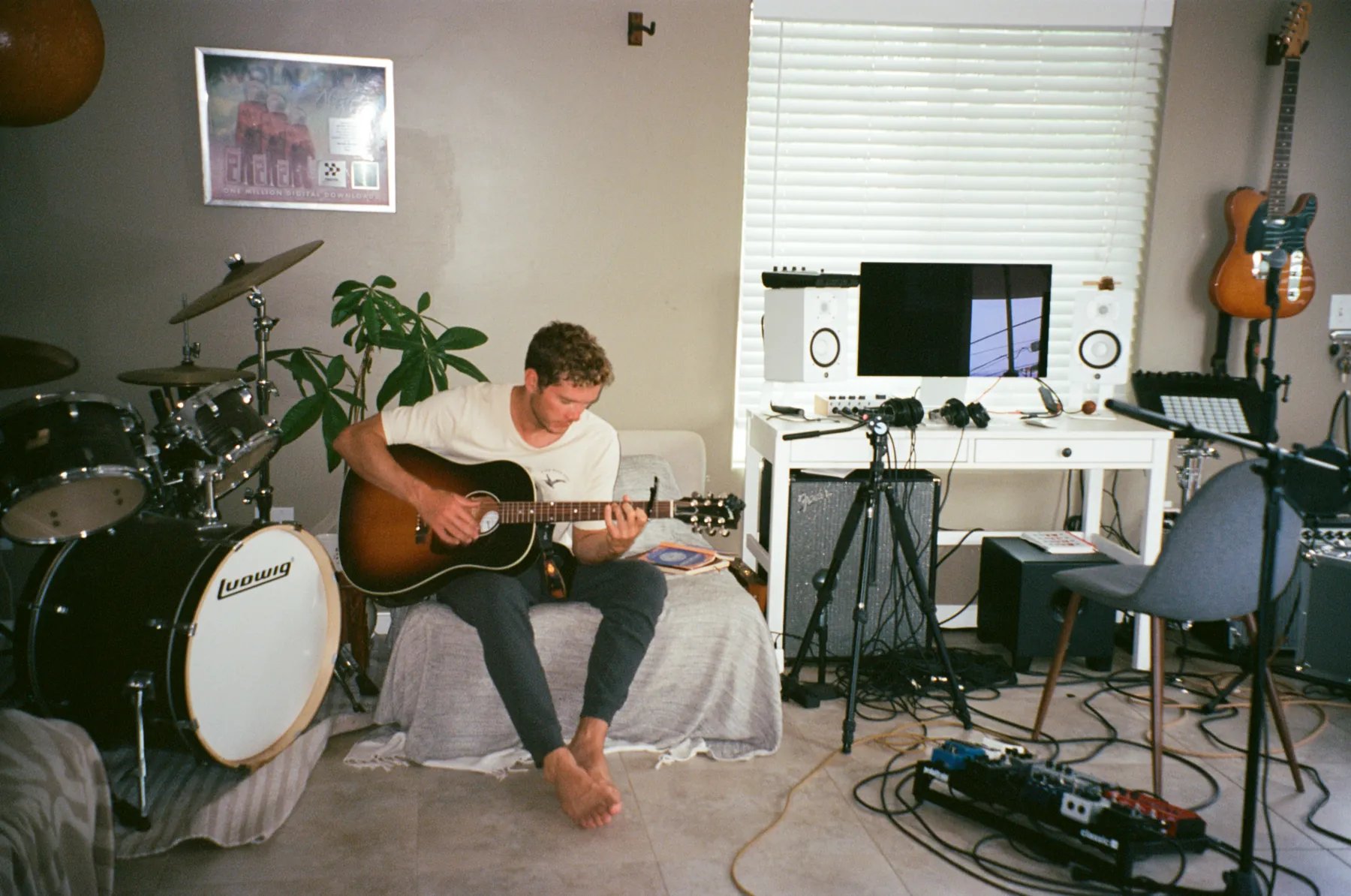
Built out of what was missing
I've loved music my whole life, and for a long stretch of it I couldn't make any. Every guitar I picked up sounded wrong, every piano hurt to listen to, and I quietly assumed that settled the question.
I got in through the side door instead. My first real venture into music was at Red Bull Records, and after that I started a platform to help artists fund their own music. Then I burned out and left all of it — the label world, the platform, the whole thing.
What brought me back was making music with nothing attached to it. No launch, no users, no plan. Just for me.
And that's when it finally clicked — not because of talent, but because I could see the whole picture at last. I never had a band, so I had to learn all of it myself: drums, bass, guitar, keys, vocals. I never got great at any one of them, but learning all of them is what taught me how music actually fits together.
I've also been writing software since I was a kid. So when something was missing, I built it instead of waiting.
It started with a tuner. I just wanted one that turned on and tuned my guitar — no ads, no subscription, no upsell.
Then it should show me the scale. Then detect the key. Then the chords that belong to it. The sampler began the same way: I wanted to learn the SP-404, so I built a replica to understand it, and once I understood it I added the parts I wished it had.
A few weeks later I looked at my phone and realised I'd built every instrument I had been wishing for. Not in a studio — in my pocket, on planes, in hotel rooms, wherever the idea turned up. That's the whole thing. Ferric is that kit, made properly.
It's also why they're built the way they are. Tools that just work. No licence checks, no sign-in wall, no verification junk that breaks the week you need it or quits the moment the wifi does. Nothing that needs you to come back daily.
Every one of those is friction between a person and an idea, and I've spent enough of my life on the wrong side of it. Take the friction out and what's left is the part that keeps you inspired.
Lower the door, not the ceiling
The goal is to lower the barrier to getting in. Not to pretend the work disappears — getting deep at any of this takes real time and real effort, and it should. But the way in shouldn't be the hard part, and for a long time that's exactly what it was.
And none of this replaces the real thing. It's meant to make you love the real thing more. To walk into a shop and finally understand why that guitar is beautiful, what that amp is actually doing, why somebody would care about a spring reverb — and to get you far enough that when you do pick one up, you can play it somewhere near its potential instead of just holding it.
Hardware isn't going anywhere, and it shouldn't. Nothing will ever replace the weight of a guitar against your ribs, or the way real keys push back under your hands. That feel is not something software is trying to win.
What software can do is carry the craft forward — the same way the synth did when new capacitors and transistors made a sound possible that had never existed before. Every generation of instrument took whatever the era handed it and made something honest out of it. The material changes. The craft doesn't. Glass and silicon are just this era's material, and our whole job is to put the soul back into them.
The instruments are a connected kit on purpose. Seeing how tuning, playing, amping and recording fit together is the thing that finally made music make sense to me.
Labelled panels, no menus, no manuals you have to survive first. Pick it up, make a sound, and learn what the control does by turning it.
Understand the tool, then go meet it in person. If one of these sends you into a shop to play a real amp — and you know what you're listening for — it worked.
I make my records on these
These are not sketchpads. I use them on my own releases — writing, jamming, tracking live. Simple enough to knock out a beat in five minutes, serious enough to run the amp into a real PA and play a room through it, and good enough to finish a studio-quality track recorded entirely on a phone, an iPad or a Mac.
I release music as SALTON — desert psych, atmospheric, made on exactly this gear. That's the only test that matters here: if an instrument isn't good enough to inspire me and earn a place on my own records, it goes back to the bench until it is.
Nothing ships from this shop that I wouldn't want to play at two in the morning. If it makes you want to pick something up and start — a phone, a guitar, whatever is nearest — then it did its job, and the rest is yours.
Say hello
I read everything. Bug reports, arguments about what a control should do, or a track you made on one of these — especially that last one. It all goes to one inbox, and a person answers.